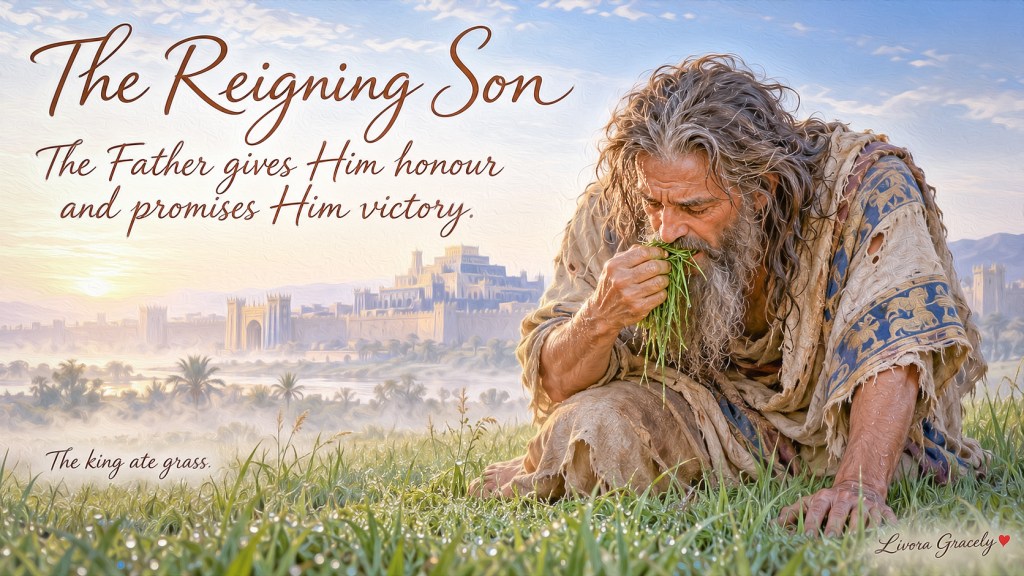
The Father gives Him honour and promises Him victory.
The king ate grass.
Dew drenched Nebuchadnezzar’s body as he lived away from human company. The ruler of Babylon could no longer command his own place among its people. His royal authority had been taken from him until he acknowledged the sovereignty of the Most High.¹
Hebrews brings another royal declaration before us. God addresses His Son:
“Sit at my right hand
until I make your enemies
a footstool for your feet.”²
The letter asks which angel ever received that invitation. Its answer gathers the preceding verses into one royal picture: the Son made the world, remains when it changes, and receives His place at the Father’s right hand.
The Father’s Address
The question recalls the one that opened this sequence of quotations: to which angel did God ever say, “You are my Son”?
Now it returns with a declaration about His place and victory. Between the two questions, the angels have been commanded to worship Him, His throne has been declared everlasting, and the earth and heavens have been named as His work. Their strength and splendour belong within God’s purposes; the Son receives the royal address that sets Him above them.
These words come from Psalm 110. There, the Lord addresses the figure David calls his lord, granting him a place at His right hand and promising the defeat of his enemies.³ Hebrews reads that declaration as spoken to the Son.
The Father speaks, and the Son receives the invitation. Their relationship continues through the honour being given. The King already described as divine is addressed by the Father whose glory He reveals. His greatness belongs within that relationship, where the Father grants honour and pledges victory.
The Right Hand
The invitation gives the Son a position of honour and royal authority. Psalm 110 joins His place at God’s right hand to the exercise of rule. The image reaches beyond physical closeness: He holds the kingship God declares.
Peter makes this connection when proclaiming Jesus’ resurrection. God has raised Him and exalted Him at His right hand. Peter then quotes the same psalm and declares the crucified Jesus to be Lord and Messiah.⁴ The One who suffered now holds the honour announced in Scripture.
Hebrews has already brought these events together: after providing purification for sins, the Son sat beside the Majesty. Later, the letter contrasts priests repeatedly offering sacrifices with Christ offering one sacrifice for sins and sitting at God’s right hand.⁵ His seat belongs with the completed offering and the royal dignity He now holds.
The Maker who remains beyond creation’s change is the same Son who provided cleansing. His saving work and His heavenly honour belong to one Person.
On the roof of his palace, Nebuchadnezzar had claimed Babylon’s greatness as the achievement of his own power. His boast was still on his lips when a voice from heaven announced that his royal authority had been taken away.
Reigning While Waiting
The word until brings a promised victory into view. The Father will make the Son’s enemies a footstool for His feet.
Opposition still exists, but the Son already reigns. Psalm 110 tells its royal figure to rule in the midst of his enemies. Hebrews later describes Christ seated at God’s right hand, waiting for their submission. His waiting takes place within the honour He holds after offering Himself for sins.
The Father is the One who pledges to bring about that submission. The Son’s authority and the Father’s action belong together: the place is given, the reign is exercised, and the final victory is promised.
The preceding verses establish the lasting character of this kingship. His throne endures, His rule is just, and His years have no end. The promise does not rest upon the changing strength of an earthly ruler. It belongs to the Son whose identity and goodness remain unchanged.
Beneath His Feet
A footstool gives the victory a vivid shape. Those who oppose the King will be placed beneath His authority.
In Joshua’s account, commanders place their feet on the necks of defeated kings.⁶ The gesture makes their defeat unmistakable. The royal promise quoted by Hebrews uses the position beneath the King’s feet to express complete subjection.
Its reach extends beyond earthly rulers. Paul writes that Christ must reign until every enemy is placed under His feet, and names death as the last enemy to be destroyed. He carries the account toward the defeat of opposing powers and the handing of the kingdom to the Father.⁷
The Son who provided purification for sins reigns toward a victory that includes the defeat of death. His authority reaches the deepest enemy of the people He came to save. The invitation at God’s right hand therefore carries both present honour and a future that no opposing power can finally prevent.
At the end of his humiliation, Nebuchadnezzar raised his eyes toward heaven. His understanding returned, and he praised the Most High. His advisers and nobles sought him out, and his kingdom was restored. The ruler who had once praised his own greatness now spoke of another King:
“Now I, Nebuchadnezzar, praise and exalt and glorify the King of heaven.”
Scripture References
- Daniel 4:28–37; closing quotation from verse 37, NIV.
- Hebrews 1:1–13; quotation from verse 13, NIV.
- Psalm 110:1–2.
- Acts 2:32–36.
- Hebrews 10:11–14.
- Joshua 10:24–25.
- 1 Corinthians 15:24–28.


Leave a Reply