The unseen Father has made Himself known.
“Try it by the window.”
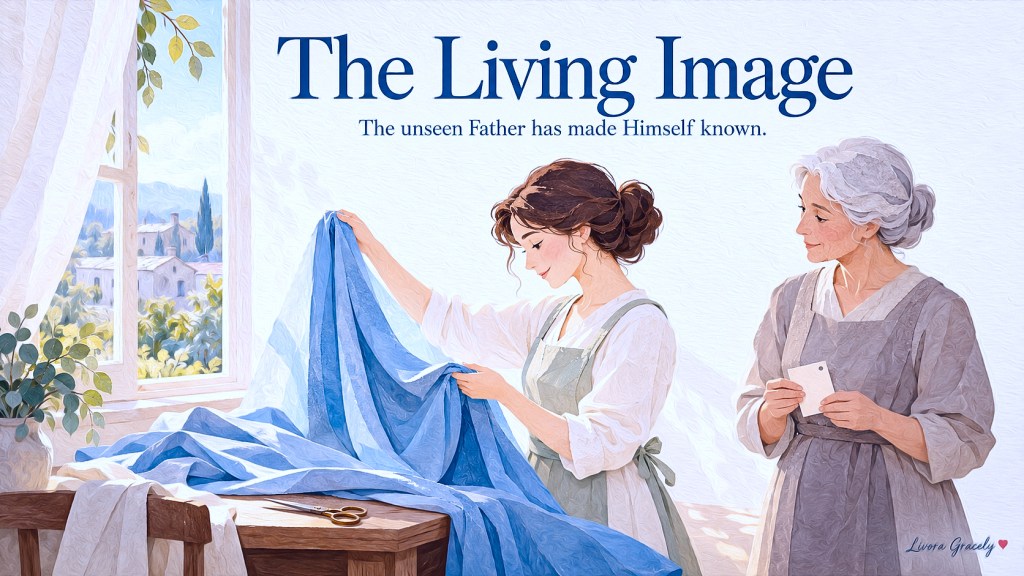
The young seamstress looked down at the cloth she had labelled grey. Her older colleague moved a pair of scissors aside and waited while she carried it across the workroom. The fabric whispered against her apron. Near the open window, the air smelled of rain from the courtyard below.
She lifted one corner into the daylight. Blue appeared along the fold, then across the length of fabric resting over her arm.
Behind her, the older woman quietly set a fresh label beside the pencil.
Hebrews has already told us that God speaks by His Son. Now it brings us closer to the One through whom He speaks:
“The Son is the radiance of God’s glory and the exact representation of his being.” — Hebrews 1:3, NIV, opening clause
The Father’s Glory
The words are familiar enough to pass over quickly. Yet Hebrews has moved beyond describing someone entrusted with a message. It is describing the Son Himself.
He is the radiance of God’s glory.
In Scripture, God’s glory sometimes becomes visible in light, cloud, or fire. But glory reaches deeper than brightness. It concerns the weight of who God is: His holiness, majesty, goodness, and power. A dazzling appearance alone would tell us very little if it revealed nothing of the One whose glory it bears.
Hebrews joins the Son directly to that glory. He does not stand outside it, pointing toward something He has only heard about. The glory belongs to God, and the Son is its radiance.
This gives another depth to the words spoken through Him. The prophets faithfully carried God’s words. The Son reveals the One whose words they carried. His place cannot be measured simply by how much information He brings.
The Father has opened more than a conversation.
He has made Himself known.
The Radiance
Radiance speaks of brightness shining forth. In Hebrews, the glory belongs to God and is made known in the Son.
Hebrews does not describe the Son as someone who has collected a few impressions of God and assembled them into a convincing account. It names Him the radiance of God’s own glory. His revelation of the Father belongs to who He is.
The sentence is also careful to keep the Father and the Son before us. The glory is God’s; the Son is its radiance. Their relationship is intimate, yet the writer continues to speak of both. The Father does not disappear when the Son is revealed.
Nor does the language require a physical glare. Hebrews is not asking its readers to imagine a face so bright that nobody could look at it. The claim reaches beyond what eyes can bear. In the Son, God’s glory is truly disclosed.
At the workroom window, the seamstress turned the cloth slowly. The upper fold had warmed in the sunlight; the length hanging against her wrist was still cool. She looked back at the label on the table, then reached for the pencil.
The Exact Imprint
Alongside the Son’s radiance, Hebrews affirms the exactness with which He reveals God’s being.
The word behind representation carries the idea of an imprint, like the distinct impression left by an engraved seal. The lines of the seal remain recognisable in the mark it leaves. In Hebrews, that exactness concerns God’s being.
The Son does not give a rough likeness of the Father, with important features blurred or missing. He reveals Him faithfully. The word exact leaves no room for a portrait that becomes less trustworthy when examined closely.
This is more than a resemblance between faces. Hebrews is not describing the shape of the Father’s eyes or explaining how two members of a family might share the same expression. It is speaking about who God is.
Together, the two expressions carry remarkable weight. Radiance speaks of glory made manifest. Exact representation speaks of the faithfulness of that revelation. The Son truly reveals God because His relationship to God reaches into His very being.
The letter has taken us far beyond an unusually gifted messenger. It places the Son in a relationship with God that no earlier prophet was given in its opening words.
The Father Known
John expresses this mystery in another way: the Son, who is Himself God and is in closest relationship with the Father, has made Him known (John 1:18).
Later, Philip asks Jesus to show the disciples the Father. Jesus answers that whoever has seen Him has seen the Father (John 14:9). He continues by speaking of the Father in Him and Himself in the Father. The relationship remains; the revelation is real.
The Son makes the Father known from within that relationship. His words and works reveal the Father with whom He lives in communion. The Father remains present; the Son’s revelation is faithful to Him.
The radiance and the exact imprint belong together. God’s glory shines in the Son, and God’s being is faithfully revealed in Him. His goodness is not blurred in the telling, nor His holiness softened into something easier to accept. What the Son reveals of the Father can be trusted.
In the workroom, the seamstress crossed out grey and wrote blue. Her colleague glanced at the new label and drew the scissors closer. Together they spread the cloth beside the window and smoothed its folds. The older woman held the far edge while the younger made the first cut. The blades gave a low rasp as they travelled through the fabric.
When the piece was laid aside, her colleague reached for the next length of cloth. The seamstress took it from her, leaving the pencil on the table.
“A moment,” she said.
The next piece went to the window first.


Leave a comment