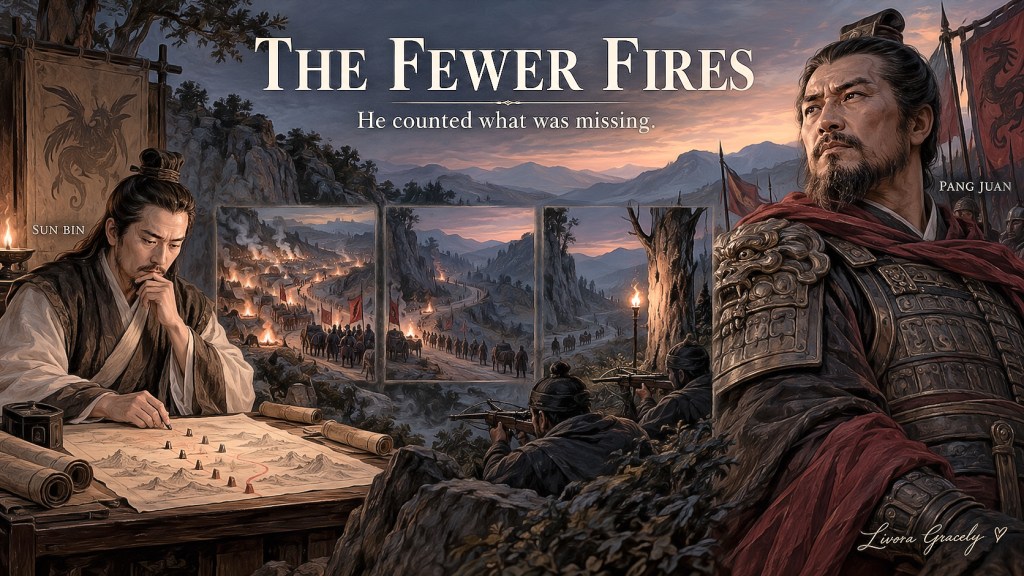
The army had been leaving fires behind.
On the first day, there were many of them.
On the second day, there were fewer.
By the third day, the fires had become noticeably fewer still.
Pang Juan watched the signs from the road and reached a conclusion.
The Qi soldiers were running away.
It was not an unreasonable conclusion. Armies left traces. Camps became smaller when soldiers deserted. A general who had spent years reading movement, distance, and retreat could hardly be blamed for noticing the numbers.
The numbers were the problem.
They had been placed there for him.
The First Stove
Sun Bin knew what Pang Juan expected to see.
Pang Juan expected a frightened army. He expected disorder. He expected soldiers who had lost confidence and begun disappearing into the countryside.
Sun Bin gave him the picture.
The Qi army moved through Wei territory, leaving cooking stoves behind as it went. The first day suggested a large force. The next day suggested a smaller one. The third day suggested that many soldiers had already gone.
Pang Juan looked at the abandoned fires and believed the army was shrinking.
He did not need much encouragement.
He left the slower part of his force behind and took a lighter unit in pursuit. The road ahead was narrow in places, and the evening was approaching, but the retreating army appeared to be losing men quickly.
The chase became easier to understand.
There were fewer fires.
There must be fewer soldiers.
Somewhere ahead, Sun Bin was running out of army.
Pang Juan continued.
The Numbers
Sun Bin had not tried to make Pang Juan believe something impossible.
That would have been poor strategy. A false sign is useful only when it resembles the truth closely enough to be accepted.
Pang Juan had experience.
He knew how an army moved. He knew how quickly soldiers deserted. He knew what a retreat looked like when discipline began to loosen.
The stoves agreed with him.
That was the difficulty.
The signs did not tell Pang Juan that Sun Bin had no army. They told him that the army was smaller than before. The first statement would have been absurd. The second sounded like ordinary military information.
So Pang Juan adjusted his pursuit.
He moved faster.
Sun Bin calculated the distance.
The road would bring Pang Juan to Maling by nightfall. The pass was narrow, with hills and trees on either side. It was the sort of place where a large force could become less useful than it looked on paper.
Sun Bin placed his soldiers in hiding.
Then he had a tree stripped of its bark.
The pale wood beneath it made a clean surface.
Words were written there:
Pang Juan dies beneath this tree.
The soldiers waited with their crossbows.
The evening darkened.
Pang Juan kept moving.
Behind him, the abandoned stoves continued to tell their story.
The Last Fire
When Pang Juan reached the tree, he saw the writing.
The road was dark. The words were difficult to read.
He ordered a torch to be lit.
The flame rose beside the tree.
Pang Juan leaned toward the message.
He had followed the fires across the road. He had counted what remained and formed a picture of what had disappeared.
Now he had found a final sign waiting for him.
The torchlight reached the words.
The crossbows were already aimed.
The first arrows came before he had finished reading.
The army broke apart in the narrow pass. Soldiers stumbled against one another. Orders disappeared into the noise. The road that had seemed to lead toward a retreating enemy became a place with very little room left in it.
Pang Juan understood the position.
The army had been defeated.
The pursuit had become the trap.
He died at Maling.
The torch went out.
The tree remained.
So did the road, the abandoned stoves, and the empty places where the fires had been.
On the first day, the fires had made the Qi army appear large.
On the second, smaller.
On the third, almost gone.
At the end, one fire was enough.


Leave a comment