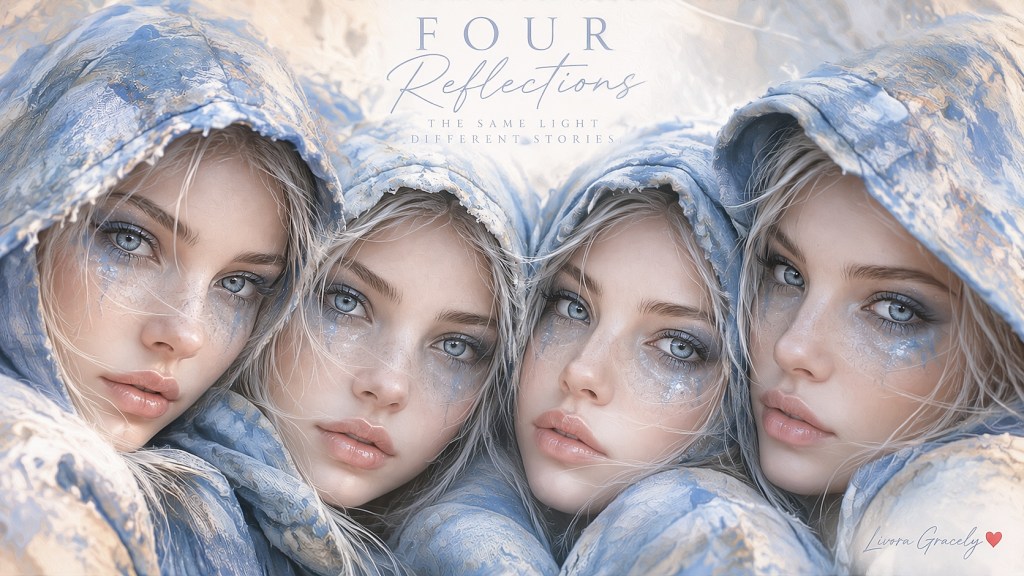
The same light. Different stories.
The photographer had one request.
“Please try not to look identical.”
Four faces looked back at him.
Same pale blue eyes. Same silver-blonde hair. Same small curve at the corner of the mouth. Even the blue hoods had been prepared from the same fabric, dusted with the same icy shimmer for the beauty campaign.
The photographer lowered his camera.
“This may be difficult.”
Mira, the eldest by eleven minutes, smiled.
“Which one of us?”
Nobody answered.
Click.
The campaign had officially begun badly.
Almost Same
The studio smelled of face powder, warm lamps, and coffee that had been forgotten long enough to become a separate beverage category.
A makeup artist moved between the sisters.
Brush.
Powder.
Silver along the cheekbones.
A touch of blue beneath the eyes.
She finished with Mira, moved to Lena, then stopped.
“Wait. Did I already do you?”
Lena pointed across the room.
“That was her.”
“Which her?”
All four sisters pointed at someone else.
The makeup artist closed her eyes.
It was going to be a long morning.
Yet the camera loved them.
Their faces fit together almost impossibly well. When they leaned close, four blue hoods became one irregular frame. Their eyes caught the same cool light. Fine strands of hair crossed their cheeks like silver threads.
Click. Click.
Perfect.
Too perfect.
The client wanted four individual portraits for the campaign as well.
That was when the trouble started.
One at a Time
Mira went first.
The photographer asked for confidence.
She lifted her chin.
Easy.
Lena came next.
“Same pose.”
She tried.
Something was wrong.
Her shoulders tightened. Her mouth became too careful.
“Relax.”
This instruction has probably never relaxed anyone.
Click.
Lena looked at the monitor.
“I look like Mira doing an impression of me.”
From behind the curtain, someone laughed.
The third sister, Elise, stepped forward.
She was supposed to look mysterious.
Instead, just as the shutter clicked, she sneezed.
The makeup artist made a small sound of despair.
The fourth, Noa, was asked for elegance.
She looked directly into the lens with such seriousness that the photographer lowered the camera.
“Are you angry?”
“No.”
“Good.”
“I’m hungry.”
That explained something.
They broke for lunch.
Four identical blue hoods appeared around a table.
The sandwiches did not survive.
The Wrong Brief
After lunch, the photographer changed something.
Not the lighting.
Not the lenses.
The instruction.
He stopped saying, “Do the same.”
He asked Mira to stand however she naturally stood.
She became still.
Not stiff.
Still.
Her portrait had quietness in it.
Lena was given no pose at all. She tucked one hand beneath her hood and glanced sideways just before the shutter.
Click.
There she was.
Elise began talking to the makeup artist between photographs. Her eyes changed when she laughed, and the photographer caught the moment immediately afterward, when the laughter had left her mouth but not yet left her face.
Click.
Noa came last.
“Elegant?” she asked.
“No.”
“Mysterious?”
“No.”
“Hungry?”
The photographer considered this.
“Just look at me.”
She did.
Click.
Everyone became quiet.
On the monitor was the same face they had been photographing all morning.
Except it wasn’t.
Four
That afternoon, the four finished portraits were placed beside one another.
Same genetics.
Same makeup.
Same blue fabric.
Same studio.
Same light.
And suddenly nobody could mistake one sister for another.
Mira’s stillness was not Lena’s watchfulness.
Lena’s watchfulness was not Elise’s warmth.
Elise’s warmth was not Noa’s directness.
The differences had always been there.
The camera had simply been too busy asking them to match.
Humans do this surprisingly often.
We meet siblings and search for resemblance.
We meet children and ask which parent they take after.
We encounter someone from a familiar family, profession, generation, or place and begin filling in the blank spaces before that person has had time to speak.
Similarity is convenient.
It helps the mind sort quickly.
But people are not filing systems.
Two children can grow beneath the same roof and remember different childhoods.
Four sisters can inherit the same eyes and use them to notice entirely different things.
Even love sometimes has to learn this.
To know someone well is not merely to recognize what they share with others.
It is to become curious about what does not repeat.
The Group Shot
Near sunset, the photographer called the sisters back for one final picture.
They gathered beneath the soft blue fabric.
Faces close.
Cheeks almost touching.
The makeup artist checked them one last time and stepped away.
“No posing,” the photographer said.
Mira looked at Lena.
Lena whispered something to Elise.
Elise tried not to laugh.
Noa heard it and rolled her eyes.
Click.
“Again.”
This time Noa smiled.
Mira blinked.
Lena looked sideways.
Elise was still laughing.
Click.
The photographer checked the screen.
Technically, it was the least perfect photograph of the day.
Four expressions.
Four slightly different angles.
One hood had slipped lower.
A strand of hair crossed the wrong cheek.
He enlarged it.
Nobody asked for another take.
The campaign had begun with four women trying not to look identical.
It ended when everyone finally stopped trying to make them different.
The photographer saved the file.
He needed a name for it.
For a moment he considered:
The Four Sisters.
Too obvious.
Then he typed:
Four Reflections.
Behind him, one sister called:
“Which one am I?”
He turned around.
Four blue hoods.
Four pale faces.
Four expectant expressions.
The photographer stared.
A long silence followed.
Apparently, discovering individuality was considerably easier than remembering everyone’s name.
The sisters gave him three seconds before laughing.


Leave a comment