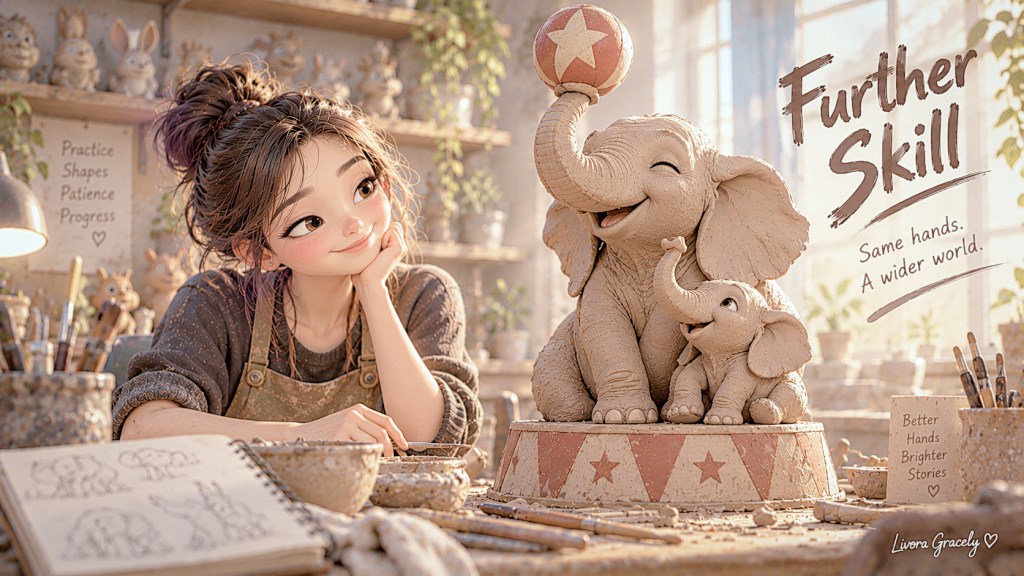
Same hands. A wider world.
The elephant had been holding the ball for nine minutes.
This was impressive.
Mostly because three years ago, its maker could barely persuade a rabbit’s ear to remain attached.
The girl—seventeen now—leaned back from the table and studied her work.
The mother elephant sat proudly on a round circus stool, trunk curled upward. At its tip rested a small ball, balanced with such improbable confidence that the elephant seemed to know an audience was watching.
Beside her sat the calf.
It wasn’t looking at the ball.
It was looking at her.
The girl noticed this and smiled.
That expression had taken nearly an hour.
Not the eyes themselves. Those had been straightforward. Nor the little raised trunk.
It was the looking.
Too much upward tilt and the calf seemed confused.
Too little and it appeared interested only in its mother’s ear.
She had reshaped the neck twice.
Three years earlier, she would have blamed the clay.
Now she simply turned the sculpture toward the window.
Warm afternoon light traveled across the mother’s wrinkled forehead, slipped into the folds behind her ears, and settled along the calf’s small back. The clay was still damp enough to carry a dark earthy smell. A wooden modeling tool rolled slowly across the table.
Tok.
She caught it before it fell.
Her father wasn’t standing behind her this time.
He didn’t need to be.
His old lessons were already in the room.
Look.
Wait.
Touch.
Look again.
She picked up the tool and deepened one fold beneath the mother’s eye.
Then stopped.
There it was.
She had become better.
Anyone could see that.
On the shelf behind her were the witnesses.
The lumpy first creature.
The rabbit with two magnificent front teeth.
Several other experiments had joined them over the years—crooked animals, ambitious heads, one mysterious object that had originally intended to become a horse.
She kept them all.
Not because they were good.
Because they were true.
They recorded hands before those hands knew what they would eventually learn.
The girl turned back to the elephants.
Something bothered her.
Technically, the mother was the more difficult sculpture. Larger body. More wrinkles. Better proportions. The ball required balance. Even the circular stool had taken careful measurement.
Yet her eyes kept returning to the calf.
It was doing almost nothing.
Just sitting.
Looking up.
Admiring.
And suddenly she laughed.
She knew that look.
Three years earlier, she had sat at this same table with her chin resting in her hands, watching her father turn a lump of clay into a face.
She remembered the impossible wink.
The tiny movements.
The long pauses.
She had thought she was merely watching him work.
Perhaps she had been doing what this little elephant was doing now.
Looking upward at something it could not yet do.
There is a peculiar moment in learning when admiration changes shape.
At first, skill looks like magic.
Someone draws a line we cannot draw. Plays a phrase our fingers cannot find. Repairs something we cannot even understand. Writes a sentence that seems to have arrived whole.
We see the result.
We don’t yet see the years inside it.
Then we practice.
Badly.
Repeatedly.
We make rabbits with enormous teeth.
And somewhere along the way, the impossible becomes difficult.
Then the difficult becomes familiar.
Then one afternoon, without ceremony, our own hands do something that would have astonished the person we used to be.
The girl brushed a crumb of clay from the calf’s ear.
The mother elephant still held her ball.
The calf still looked upward.
But now the girl understood something else.
Learning had not made her stop looking up.
It had simply changed what she could see when she did.
At fourteen, she had seen her father’s finished face.
At seventeen, she would have noticed the pressure of his thumb, the angle of his tool, the pause before the next decision.
Greater skill had not made wonder smaller.
It had given wonder more details.
She placed the tool down.
For a moment, the three of them seemed perfectly still:
the mother with her impossible ball,
the calf with its impossible admiration,
and the young artist standing somewhere between the shelf behind her and everything her hands had not made yet.
Three years ago, she had watched someone else’s hands and wondered:
How can he do that?
Now the little elephant appeared to be asking the same question of her.
She looked at it and grinned.
“Keep watching.”
The calf, wisely, said nothing.


Leave a comment