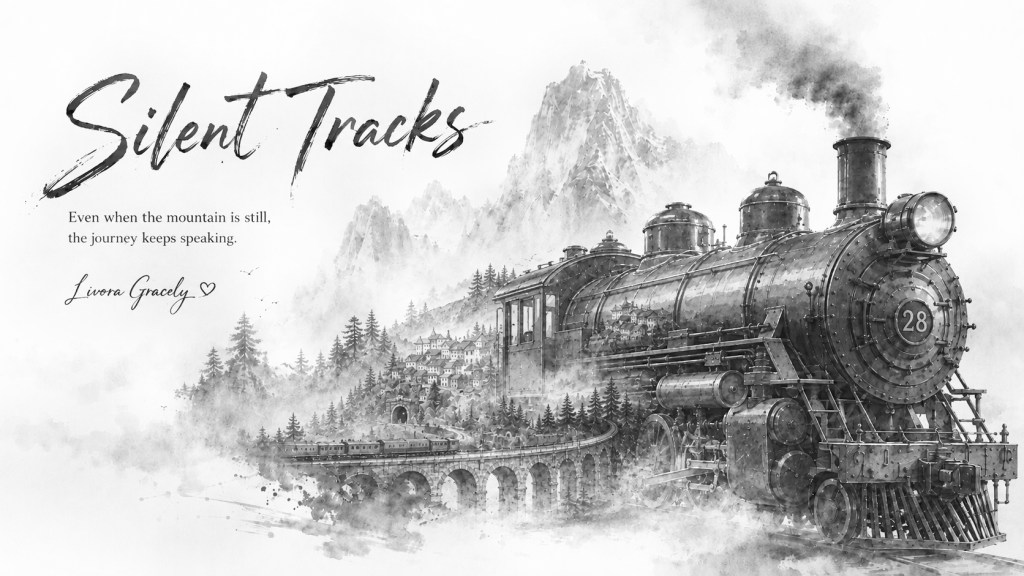
Even when the mountain is still, the journey keeps speaking.
The stationmaster blamed the mountain.
It had been standing in exactly the same place for several thousand years, yet every morning people arrived convinced they needed to be somewhere on the other side of it.
At six-fifteen, Engine 28 answered them.
Steam first.
Then the whistle.
Then enough iron, coal, luggage, letters, milk cans, medicine, newspapers, umbrellas, and impatient people to make the platform reconsider its size.
Mr. Bell, the conductor, carried a pocket watch with the seriousness of a surgeon.
“Two minutes,” he announced.
A woman boarded with three hatboxes.
A baker handed over six baskets of bread.
A farmer loaded two crates of apples and one goat that had not purchased a ticket.
The goat was assigned to freight.
It disagreed loudly.
At six-seventeen, Engine 28 moved.
The village began shrinking behind it.
This was the first strange thing about trains: places that had once required days of dust, tired horses, and several arguments about directions could now arrive before lunch.
The second strange thing was what happened inside.
A letter written beside one fireplace travelled with medicine for a child who had never seen that fireplace.
Fresh bread crossed a valley.
A newspaper crossed three towns before its headline became old.
A grandmother carrying knitted socks sat beside a businessman carrying documents marked URGENT.
Neither asked which cargo mattered more.
At the mountain pass, snow had covered the rails.
The engine slowed.
Mr. Bell checked his watch.
Everyone checked Mr. Bell.
The goat checked nothing.
Workers cleared the track while steam drifted through the pines.
For twenty-three minutes, the fastest thing most passengers had ever known simply waited.
The businessman sighed.
The grandmother opened one of her parcels.
“Sock?”
He looked at her.
“My feet are fine.”
“Then you can hold the yarn.”
By the time the track reopened, carriage three had acquired a knitting committee.
Engine 28 entered the tunnel six minutes late and emerged into sunlight carrying exactly the same passengers—
except the businessman was now responsible for blue wool.
That evening, Mr. Bell recorded the delay carefully.
23 minutes. Snow.
Then, after considering the day, he added another line beneath it.
One sock unfinished.
For years afterward, the railway office kept increasingly accurate records of distance, coal, weather, passengers, and time.
Nobody officially recorded what happened between stations.
Engine 28 kept carrying it anyway.


Leave a Reply