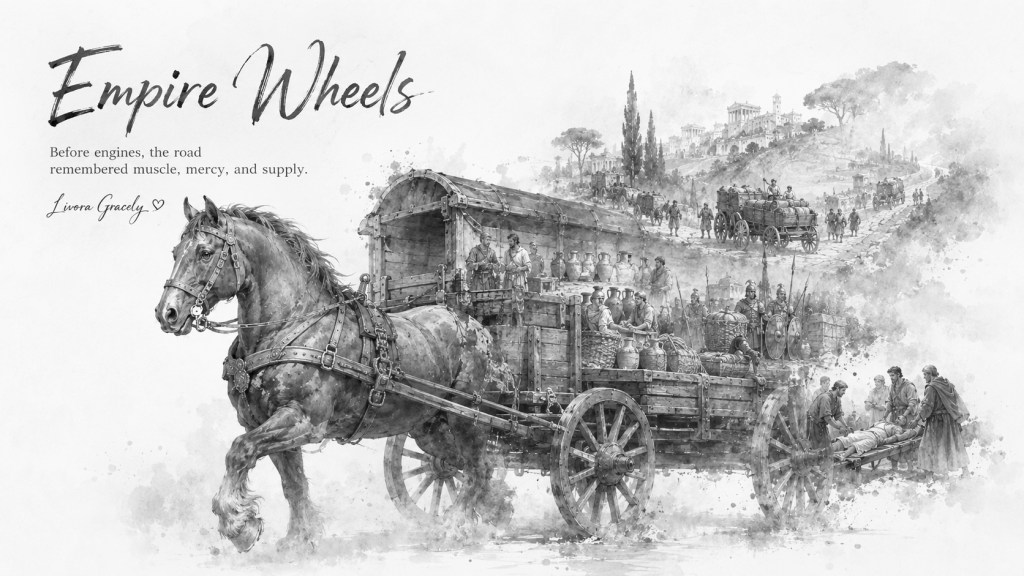
The cart carried almost everything. One corner stayed unclaimed.
At sunrise, Marcus’s wagon belonged to onions.
This was not official.
Nothing involving onions was ever official enough for Marcus.
Twelve baskets went in first, followed by two jars of oil, a sack of flour, three nervous chickens, and a merchant who insisted he was not part of the cargo.
The horse disagreed.
By the second milestone, the wagon had become public transportation.
An old woman climbed aboard because the road was steep. A boy joined because the old woman had figs. His mother followed because the boy had joined.
Marcus looked at the remaining space.
“Still a cart,” he said.
By noon, soldiers stopped him near the eastern road.
They needed grain carried to a camp beyond the hills.
The onions moved left.
The chickens objected.
The merchant became responsible for explaining this to them.
By afternoon, Marcus was returning with an almost empty wagon when someone waved from beside the road.
A traveler had fallen ill.
The flour sacks became a pillow. A folded army blanket became a bed. The old woman, who had somehow remained aboard through every change of purpose, produced water.
Nobody asked whether the wagon was still transporting goods.
The chickens had already stopped caring.
That evening Marcus reached town carrying no onions, no grain, and no merchant.
Only the sick traveler, his worried brother, two empty baskets, one sleeping chicken, and a helmet that apparently belonged to nobody.
The clerk at the gate stared at the wagon.
He had spent several months trying to decide what kind of vehicle Marcus operated.
“Freight?” he asked.
“Sometimes.”
“Passengers?”
“Frequently.”
“Military supply?”
“Apparently.”
“Ambulance?”
Marcus considered the sleeping chicken.
“Today was complicated.”
The clerk opened a fresh line on his tablet.
Marcus drove home before another category could happen.
The next morning, the wagon was loaded again.
Wine jars.
Bundles of cloth.
Bread.
A carpenter carrying one chair for reasons he refused to discuss.
Marcus tied everything down carefully.
Then he moved one basket six inches to the left.
His son noticed.
“There’s still room.”
Marcus nodded.
“For what?”
Marcus picked up the reins.
The road ahead was already filling with people.
“Don’t know yet.”
After that, no matter how full the wagon became, one small corner was always left empty.
Eventually the chickens learned not to sit there.


Leave a Reply