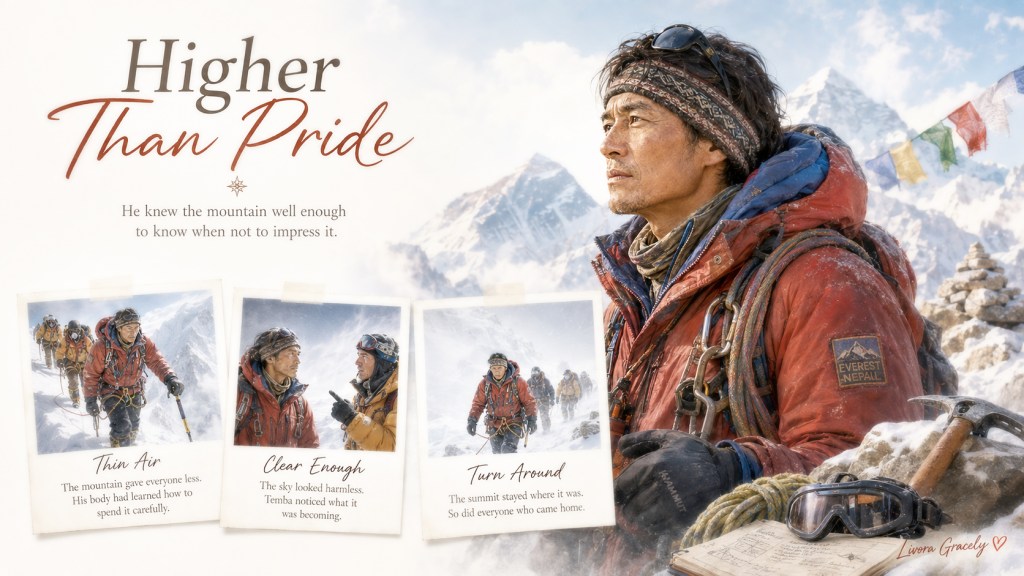
He knew the mountain well enough to know when not to impress it.
Temba Norbu distrusted beautiful mornings.
Not all of them.
Only the ones above eight thousand meters.
At Camp Four, the sky was blue, the wind had softened, and Charles Vane was standing outside his tent announcing that this was “exactly the weather we paid for.”
Temba tightened a crampon strap.
“The mountain hasn’t seen your invoice.”
Charles did not laugh.
The cook did.
By two-thirty the next morning, five headlamps were moving upward toward Everest’s summit.
Charles carried bottled oxygen.
So did the other foreign climbers.
Temba did not.
It was not bravado. Sherpa communities had lived at high altitude for generations, and people like Temba were unusually adapted to thin air. But he knew something tourists often misunderstood: adaptation did not make anyone immune to altitude.
The mountain still collected mistakes.
Temba simply spent oxygen differently.
Step.
Breathe.
Look.
Wait.
Above them, the world became mostly snow, rock, darkness, and decisions.
Charles climbed strongly.
Too strongly.
He passed another team near the Balcony and turned back with a grin.
“Good pace.”
Temba looked at his watch.
Then at the plume forming beyond the ridge.
“Too good.”
Charles frowned.
There was almost no wind where they stood.
The stars were still visible.
The summit looked close enough to encourage bad mathematics.
At sunrise they climbed higher.
Behind them, Earth curved away in pale blue distance.
Ahead, clouds were beginning to gather where Charles saw only clear sky.
Temba stopped.
Charles nearly walked into him.
“Why?”
“Wind is turning.”
Charles looked around theatrically.
“What wind?”
Temba pointed toward a faint ribbon of snow lifting from the ridge.
“That one.”
It looked harmless.
That was the problem.
Temba had spent years watching weather announce itself quietly before becoming loud enough for everyone else.
“We turn.”
Charles stared at him.
“The summit is right there.”
“Yes.”
“I paid for the summit.”
Temba pulled his glove tighter.
“The summit didn’t receive payment.”
This time nobody laughed.
Charles became angry enough to produce several expensive words.
He had trained for eighteen months.
He had flown halfway around the world.
He had paid guides, permits, equipment, oxygen, insurance, and an amount of money he preferred not to calculate while standing in snow.
Temba listened.
Then he said, “You can be angry while walking down.”
Charles refused.
For eleven minutes.
Temba waited.
Not because he lacked authority.
Because anger at altitude consumed oxygen too.
Finally, one of the other climbers spoke.
“I’m going with Temba.”
Then another.
Charles looked toward the summit.
Nothing had moved.
That was its unfair advantage.
They descended.
An hour later, the wind arrived.
Not dramatically at first.
Snow began sliding sideways.
Visibility shortened.
The ridge disappeared behind blowing white.
Charles stopped speaking.
Temba moved the group closer together.
One climber’s regulator began icing.
Another stumbled repeatedly.
Temba shifted loads, shortened intervals, checked gloves, checked faces, checked answers.
“What’s your name?”
“Daniel.”
“Where are we?”
“Everest.”
“Too general.”
Even Charles smiled at that.
By the time they reached safer ground, nobody cared how close the summit had been.
They cared about tea.
Three days later, Charles found Temba at Base Camp repairing a torn strap.
For a while he said nothing.
Then:
“Would we have made it?”
Temba kept stitching.
“Maybe.”
Charles waited.
“And back?”
Temba looked toward the mountain.
Above the tents, Everest was shining as if nothing had happened.
“That,” he said, “was the expensive part.”
Charles sat beside him.
No argument.
No invoice.
Just two cups of tea cooling between them and a summit still exactly where they had left it.
Research basis: Temba and Charles are fictional. Sherpa high-altitude adaptation is well documented, including greater efficiency in oxygen use; however, this does not eliminate the dangers of extreme altitude. Ang Rita Sherpa’s real record of ten Everest ascents without bottled oxygen shows how extraordinary—but still human—high-altitude performance can be. PubMed


Leave a Reply