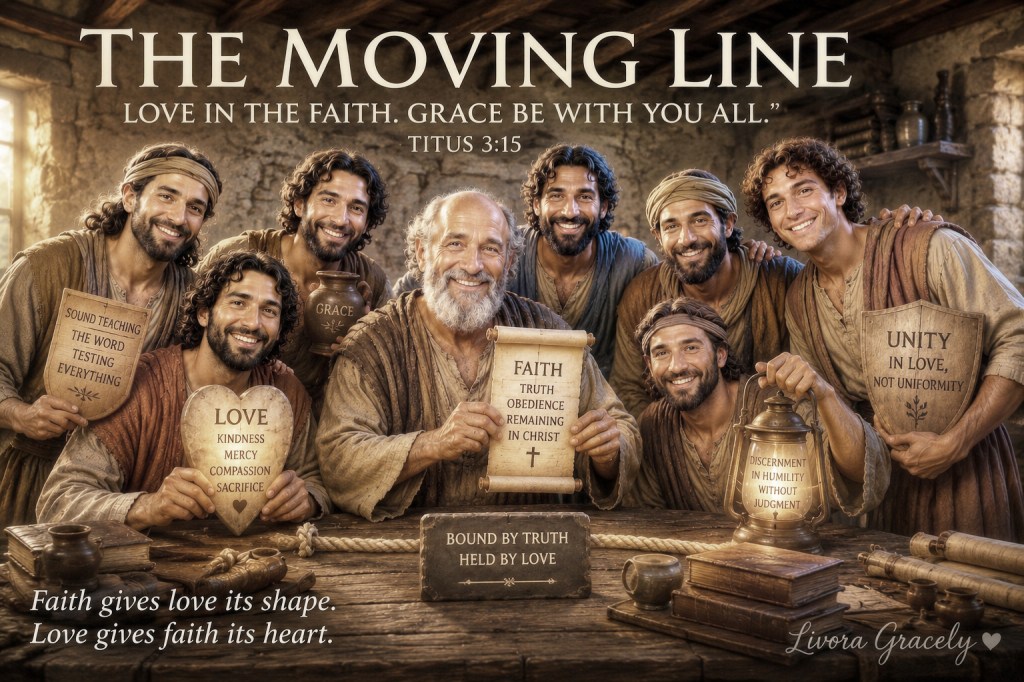
Titus 3:15, NIV
“Everyone with me sends you greetings. Greet those who love us in the faith. Grace be with you all.”
Love Has an Address
The letter is almost over.
Paul has already written about truth and character, households and leaders, difficult people and good works. Titus has been told what deserves correction, what needs strengthening, and what kind of life should grow from sound teaching.
Then the language softens.
“Everyone with me sends you greetings.”
There are no arguments left to settle. No instructions to organize. People who are with Paul remember people who are with Titus.
Then comes an easily overlooked phrase:
“Greet those who love us in the faith.”
Paul could have stopped with love.
He does not.
The love he describes has an address. It lives in the faith.
That small phrase keeps two things together that people often pull apart. Love can become so afraid of offending that it refuses to name what is false. Faith can become so occupied with being correct that the person standing across the room becomes little more than an error to defeat.
Paul gives us neither.
There is love.
There is the faith.
And somehow they inhabit the same sentence.
A river needs banks, not because the banks oppose the water, but because without them the river eventually becomes something else. Its width may change. Its current may slow. Rain may make it rise. But the banks still give the water a course.
Faith does not make love smaller.
It gives love somewhere to remain.
Dust Is Not Departure
That raises an uncomfortable question.
If faith has a shape, what happens when a follower of Jesus fails to fit it perfectly?
The answer cannot be perfection.
On the night before the cross, Jesus washed His disciples’ feet. Peter resisted, then overcorrected and asked for his hands and head as well. Jesus answered with an image both ordinary and profound: the person who has bathed needs only to wash his feet.
A clean person can still collect dust.
Feet touch roads.
They step through courtyards, climb slopes, enter crowded streets, and sometimes stand where they should not have stood. Dust comes with the journey.
The Christian life does not become false every time dirt appears.
Peter himself would make that painfully clear. The man who confessed Jesus would later deny knowing Him. Yet his failure was not given a new name so that it could remain comfortably beside his faith. Peter wept. Later, beside another fire, Jesus restored him and sent him back to the work.
There is an enormous difference between having something that needs washing and deciding that it is no longer dirty.
A person may struggle with sin and still be moving toward Christ.
A person may misunderstand Scripture and remain teachable.
A person may fall badly and still discover that repentance has a road home.
The dividing line is not between people who have dust and people who do not.
Everyone on the road has dusty feet.
Something more serious happens when we stop bringing them to the basin.
When the Line Moves
Pergamum knew the difference.
Jesus did not speak to that church as though nothing good remained there. They had held fast to His name in a hostile place. Antipas had been killed among them, and still they had not renounced their faith.
Then came the word nevertheless.
There were teachings among them that Jesus would not allow their courage to excuse. Revelation speaks of the teaching of Balaam and of the Nicolaitans, connected there with idolatrous compromise and sexual immorality.
The church had endured pressure from outside.
Now another danger was living inside.
This is where tolerance can become difficult to distinguish from surrender.
The most dangerous change may not begin when someone openly says, “I no longer want Christ.”
It may begin much more quietly.
Christ is retained.
Christian language is retained.
Worship may be retained.
But something Christ calls us to leave is gradually given permission to stay.
At first there is discomfort. Then explanation. Then accommodation. Eventually the old boundary begins to look unnecessarily severe.
The line has moved.
This is different from the disciple who falls and says, “Lord, change me.”
Here the temptation is to say:
“Lord, change what You call true.”
That is why sound teaching matters. It is not theological decoration for unusually serious Christians. It protects us from creating a Christ who never contradicts us.
A Jesus who approves everything we already believe, desire, and practice may eventually bear less resemblance to the Jesus we follow than to ourselves.
Lines We Did Not Draw
But there is another way to move the line.
We can move it outward.
A group of believers sits around a table. They agree that Christ is Lord, confess the same gospel, open the same Scriptures, and desire to follow Him.
Then the smaller lines begin appearing.
One worships differently.
Another belongs to a tradition we do not understand.
Someone interprets a secondary passage differently. Someone prays with unfamiliar words. Another observes a practice our congregation never adopted.
Soon preferences begin receiving the authority of commandments.
The line moves again.
Only this time, instead of bringing something false inside, we push someone outside whom Christ has not told us to exclude.
This danger can hide particularly well inside zeal for truth.
Jesus warned people who could see a speck in another person’s eye while remaining strangely untroubled by the plank in their own. Paul repeatedly had to teach communities how to live with differences that did not overturn the gospel.
Discernment therefore requires two kinds of courage.
The courage to say, “This cannot be made compatible with the gospel.”
And the humility to say, “This may be different from me without being outside Christ.”
Without the first, faith dissolves into preference.
Without the second, preference disguises itself as faith.
An article about true followers can therefore become dangerous in an unexpected way. We begin wanting to recognize what belongs to Christ, and before long we are constructing a smaller circle called:
people like us.
But we are not the circumference.
Christ is.
The gospel is not whatever our group has grown accustomed to defending. Nor does something become true merely because our age has grown uncomfortable calling it false.
The line is received before it is applied.
The Shape of Love
Now Paul’s final sentence sounds different.
“Greet those who love us in the faith.”
Not merely those who agree with us.
Not those who have never failed.
Not those whose feet have somehow crossed the road without collecting dust.
And not a love emptied of truth until it can contain anything.
Paul places love inside faith and then immediately says:
“Grace be with you all.”
The order matters.
Faith gives the relationship its shape.
Grace fills the room.
That makes the question of the true follower much less convenient than a checklist.
It is easy to examine someone else’s life and ask whether that person has crossed the line. It is harder to stand before Scripture when Scripture crosses us.
There will be moments when the Word agrees with what we already believe. Those moments cost little.
The revealing moments come when it does not.
When Scripture exposes an affection we want to protect.
When Christ’s words disturb an arrangement we have learned to enjoy.
When repentance threatens something we would rather rename.
When another believer does not fit the boundaries our own community has drawn.
Then the deeper question is no longer:
Where does that person stand?
It becomes:
When Christ and I disagree, which one of us is allowed to move the line?
The answer is what makes discipleship discipleship.
The road continues. Dust will return. There will be more things to learn, more assumptions to surrender, more sins to confess, more brothers and sisters who test the size of our love.
The basin has not disappeared.
Neither have the banks of the river.
And the table remains set for people who still need grace.
A true follower is not recognized because nothing ever needs washing. The mark is quieter than that: when the dust becomes visible, the feet still come back to Christ.
Love remains.
Truth remains.
Grace remains.
And perhaps Paul’s small phrase at the bottom of an old letter has been holding them together all along:
Faith does not make love smaller.
It keeps love from becoming something else.
Scripture Notes
Titus 3:15 — Paul’s closing greeting holds love and faith together: “those who love us in the faith,” followed immediately by grace for all. This small phrase provides the article’s central frame: Christian love has breadth, but it does not lose the shape given by the faith.
John 13:6–10 — When Jesus washes the disciples’ feet, Peter first resists and then asks for more than is needed. Jesus’ answer provides the article’s image of discipleship: belonging to Him does not mean that nothing ever needs washing. The journey still gathers dust.
Luke 22:54–62; John 21:9–19 — Peter’s denial and later restoration distinguish failure from surrender. Peter falls seriously, but his failure is not renamed as faithfulness; he grieves, returns, and is restored by Christ.
Revelation 2:12–16 — The church in Pergamum had remained faithful to Christ’s name under severe pressure, yet Jesus still confronted teachings associated with Balaam and the Nicolaitans. Their courage did not make compromise harmless. This becomes the article’s clearest picture of a boundary that cannot simply be moved.
Matthew 7:3–5 — Jesus’ image of the speck and the plank warns that discernment can become distorted when truth is used mainly to examine others while leaving ourselves unexamined.
Romans 14:1–13 — Paul shows that genuine differences can exist among believers without every difference becoming a boundary of the gospel. Christians are warned against both despising and judging one another over disputed matters, leaving room for conviction without turning personal practice into the measure of another believer.


Leave a Reply