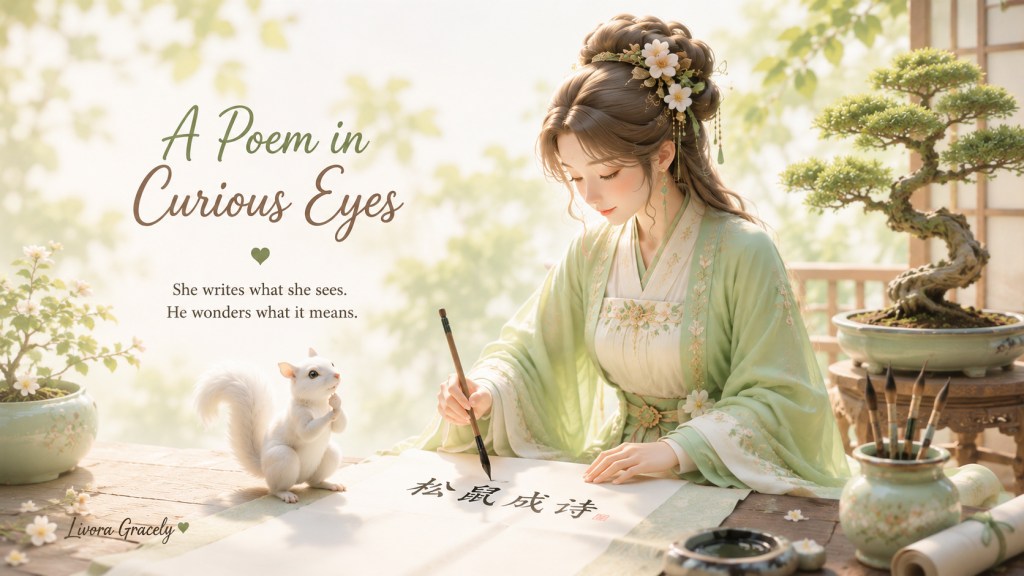
Pip had watched Elowen turn water into bubbles.
Ink was far more suspicious.
That morning, Elowen decided she would learn to write a poem.
Not type one.
Not think one.
Write one properly—with a brush, black ink, and a sheet of white paper large enough to make every mistake look important.
She settled on the bright veranda beside the bonsai, arranged her brushes, and dipped one carefully into the ink.
Pip appeared before the first stroke was finished.
He climbed onto the table and stared.
Elowen drew one dark line.
Pip leaned closer.
Another line crossed it.
Pip raised one eyebrow.
Then came a curve, a hook, and several confident strokes that Pip considered increasingly difficult to defend.
He put one tiny paw beneath his chin.
Elowen noticed him.
“You don’t approve?”
Pip looked at the paper.
Then at the brush.
Then back at Elowen.
She continued writing.
松鼠成诗
Four characters rested in wet black ink.
Pip stepped closer.
He sniffed the first character.
Nothing.
He inspected the second.
Still nothing.
Whatever Elowen was making, it had no scent, could not be eaten, and appeared to have ruined a perfectly good sheet of white paper.
Elowen smiled.
“The squirrel becomes poetry.”
Pip looked behind himself.
No other squirrel.
He looked under the table.
Still none.
Then he slowly turned back toward the paper.
Elowen laughed.
She had spent the morning trying to find something beautiful enough to write about—the bonsai, the sunlight, the flowers moving beyond the veranda.
All the while, her subject had been standing beside her, questioning every brushstroke.
Pip reached toward the paper.
Elowen gently caught his paw before it touched the wet ink.
For a moment they simply looked at each other.
Perhaps poems did not always begin with extraordinary things.
Sometimes something ordinary stayed beside us long enough for us to finally see it.
Elowen added one final stroke.
Pip returned his paw to his chin.
He still did not understand poetry.
But he was beginning to suspect it was about him.


Leave a Reply