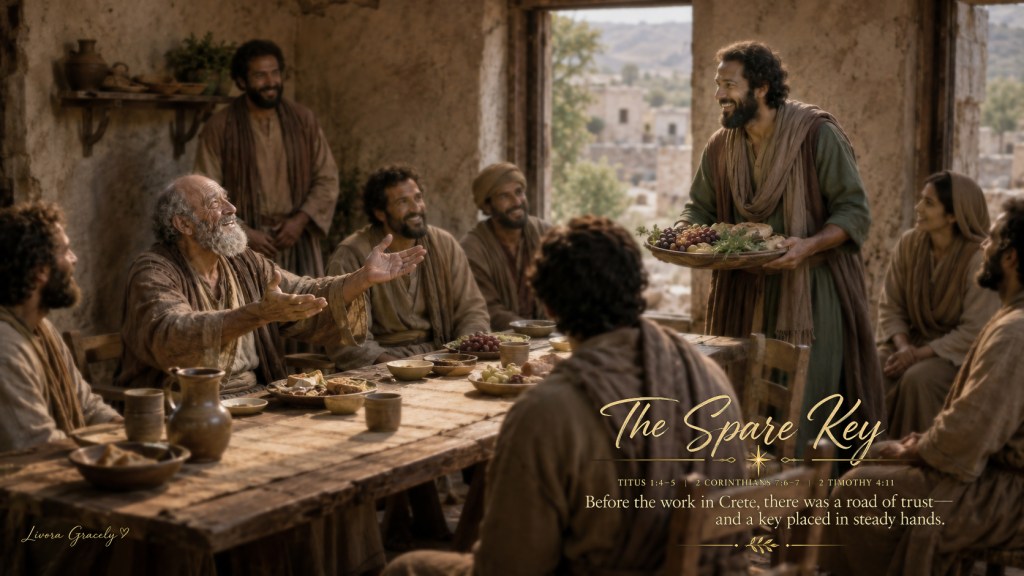
Preface
With our journey through Paul’s letters to Timothy now complete, we begin a new road with Titus.
Titus was not a stranger to Paul’s work. He had traveled with him, stood beside him during difficult questions in the early church, entered Corinth during a strained season, and returned carrying news Paul had been waiting to hear.
Yet Titus was not another Timothy.
The two men shared Paul’s trust, but they came from different backgrounds, traveled different roads, and were eventually given different fields of responsibility.
Timothy remained in Ephesus.
Titus was left in Crete.
Before we move into the instructions Paul gave him there, it is worth meeting the man who received them.
The Spare Key begins with that earlier road—before Crete, before the elders, and before the unfinished work.
It asks a quieter question:
What happens before someone can be trusted with work another person must leave behind?
This is where our journey through Titus begins.
Titus 1:4–5 · 2 Corinthians 7:6–7 · 2 Timothy 4:11
Incoming Dust
A traveler was coming through Macedonia with dust along the lower edge of his clothes.
Paul had been waiting for him.
The road behind the man led back toward Corinth, where questions had been left to settle among people Paul knew well. A letter had gone ahead. Titus had followed it into the church. Now he was returning with what could not be learned from a distance.
Titus had not been in Troas when Paul looked for him there. Paul had continued into Macedonia without him.
Now the missing man was coming up the road.
His name had appeared beside Paul before, but this journey showed something different. Titus had gone where Paul was not, entered a difficult situation in his name, observed what happened there, and come back able to give an account.
Paul later wrote:
“God, who comforts the downcast, comforted us by the coming of Titus.”
The report included the Corinthians’ longing, their mourning, and their concern for Paul. Titus had seen their response himself. He was not carrying rumor from one city to another. He had been among the people whose news he now brought.
This was not the beginning of Titus’s road with Paul.
Neither was it the end.
Before there was an island where Paul could leave him, there had been roads where Titus learned to walk beside him, journeys where he was sent ahead, and places from which he was expected to return.
In Macedonia, one of those roads had brought him back.
Different Clay
Titus had already stood beside Paul in a moment when much more than travel was at stake.
Years earlier, Paul took him to Jerusalem.
Titus was Greek.
And he was uncircumcised.
The question surrounding men like him reached into the heart of the young church. Could a Gentile belong fully to Christ without first taking on the marks of Jewish identity?
Paul remembered the pressure clearly enough to write:
“Yet not even Titus, who was with me, was compelled to be circumcised.”
Titus did not stand there as an argument on parchment. His own body was inside the argument.
That makes his story especially striking beside Timothy’s.
Timothy had a Jewish mother and a Greek father. Scripture had been planted in his life from childhood through Eunice and Lois. When Paul took him along, Timothy was circumcised because the Jews in that region knew his father was Greek.
Titus was not.
One young man received circumcision before going farther into the mission. The other remained uncircumcised while men were pressing the question of what Gentile believers needed in order to belong.
The difference could have pulled them into opposing stories.
It did not.
Paul loved both men. He worked with both. He entrusted churches to both. The same apostle who refused to circumcise Titus chose to circumcise Timothy.
The gospel had not changed between them.
The circumstances had.
Timothy’s circumcision could remove an obstacle from the road before him. Compelling Titus to be circumcised would have made that obstacle into a condition of belonging.
Paul did not need one man to become the other.
Years later their letters would sound like relatives. Both would deal with leadership, teaching, conduct, false teachers, households, and lives shaped by sound doctrine.
Yet Paul had not prepared two copies.
He had known two men.
And he had learned where each could stand.
Longer Leash
Trust did not arrive all at once.
At first Titus could be seen beside Paul. Later, he could be sent where Paul himself was not.
Corinth became part of that movement.
Titus entered the church carrying responsibility that could not be completed simply by delivering a message. He had to remain among the people, see their response, and return with an account.
He did.
Distance had begun to reveal what companionship alone could not.
Other names around Paul show that the result was never automatic.
Demas had also belonged to Paul’s circle of coworkers. Earlier letters preserve his name among them. Near the end, however, Paul recorded that Demas had left.
Mark’s road had taken another turn.
During an early missionary journey, Mark returned from the work. Later, Paul did not want to take him again, while Barnabas did. The disagreement became serious enough that Paul and Barnabas traveled separately.
That was not Mark’s final place in the record.
Near the end of Paul’s life, his name appeared again:
“Get Mark and bring him with you, because he is useful to me for ministry.”
Useful.
An earlier departure had not become a permanent verdict.
The three roads therefore did not produce the same result.
Demas had worked near Paul and eventually left. Mark had once turned back and later became useful again. Titus continued to receive assignments that required him to work at increasing distance from the man who had trained him.
Opportunity opened the road.
Time showed who could carry what came with it.
Wrong Address
Timothy was in Ephesus.
Titus was left in Crete.
Exchange the addresses for a moment.
Put Titus among the Ephesians. Send Timothy across to Crete.
Nothing about the gospel itself would need to change. Both men were trusted coworkers. Both would receive instruction concerning sound teaching, leadership, conduct, and the health of churches.
Yet the exchange feels increasingly strange once their roads are remembered.
Ephesus already carried years of Paul’s own labor. He had taught there extensively. Its elders had heard his warnings. Problems concerning teaching and the life of an established church were no longer distant possibilities. Timothy was serving inside a place with history behind it.
Crete met Titus differently.
Paul’s sentence is brief:
“The reason I left you in Crete was that you might put what remained into order.”
Something remained.
Something was not yet in order.
Paul would not stay to finish it himself.
The text does not give his private calculation. It never tells us that Titus had one personality type and Timothy another. It gives no chart explaining why the two men were not exchanged.
Instead, it gives us their roads.
Paul knew Timothy’s history.
He knew Titus’s.
Years of working with people had also shown him what distance could reveal. Proximity did not guarantee perseverance. A man who once turned back could later become useful again. Titus himself had already carried responsibility beyond Paul’s immediate reach.
That changes the sound of “I left you in Crete.”
The sentence is not merely geographical.
A man who once traveled beside Paul was now standing where Paul would no longer stand beside him.
There were towns beyond the sentence. People would have to be recognized. Leaders would have to be appointed. Teaching would have to be faced. Decisions would no longer arrive with Paul physically in the room.
The distance had become real.
So had the trust.
After Departure
Paul wrote to Titus by name.
That placed the letter among a small group. Paul wrote to churches, but he also wrote to Philemon, Timothy, and Titus—individual people carrying responsibilities that extended beyond themselves.
Philemon would face Onesimus.
Timothy had work in Ephesus.
Titus remained in Crete.
The letter would soon speak about elders, teaching, households, conduct, and the life of believers among their neighbors. Those matters belong to the road ahead.
For now, the opening gives enough.
Titus had traveled with Paul.
He had stood with him in Jerusalem.
He had been sent into Corinth.
He had returned through Macedonia.
Then came another place, and the arrangement changed.
Paul went on.
Titus did not.
The work there had not reached its finished form. That fact did not prevent Paul from departing. The next part could be placed into another pair of hands.
There had been a time for walking beside Paul.
A time for being sent.
A time for returning.
Then came a place where returning was not the immediate assignment.
Paul left Crete.
Titus remained.
Witness Notes
2 Cor. 2:12-13 — Paul’s search for Titus at Troas shows that Titus had become a trusted presence in the work.
2 Cor. 7:5-7 — Titus returns from Corinth, and his arrival brings Paul both news and comfort.
Gal. 2:1-5 — Titus remains uncircumcised when Gentile freedom in the gospel is under pressure.
Acts 16:1-3 — Timothy’s circumcision shows how a different worker could face a different missionary circumstance without changing the gospel.
2 Cor. 7:13-16 — Titus proves able to enter a difficult church situation and return with strengthened confidence in the Corinthians.
Col. 4:14; 2 Tim. 4:10 — Demas shows that proximity to Paul’s ministry does not guarantee perseverance.
Acts 13:13; 15:37-40 — Mark’s early withdrawal shows that a worker can fail under responsibility.
2 Tim. 4:11 — Mark’s later usefulness shows that an earlier failure does not have to become a final verdict.
1 Tim. 1:3-7 — Timothy’s work in Ephesus centers on guarding an established church against false teaching.
Titus 1:4-5 — Paul leaves Titus in Crete to put unfinished work in order and appoint elders.


Leave a comment