Livora Gracely

Writing to remember, sharing to inspire

  • PART 3-The Day That Did Not Hurry

    The battle in the valley of Gibeon moved quickly after the first clash.

    The armies of the five kings had not fully formed when the attack came. Lines that should have held their shape began to break apart. Some soldiers tried to regroup along the slopes, but others were already turning toward the western road that led away from the valley.

    Dust rose thick in the air.

    Shouts mingled with the sound of shields striking against one another. Horses that had not yet been saddled properly ran without direction. Men who had been sitting near their morning fires were now running down rocky paths with hurried breath.

    Behind them the army of Israel pressed forward.

    They drove the fleeing soldiers out of the valley and toward the road that climbed through Beth-Horon. The path wound through steep stone ridges before descending toward the plains beyond.

    In places like that, broken armies rarely recover.

    Yet another problem was beginning to appear.

    The sun had already risen high.

    Shadows shortened across the rocky ground. The soldiers who were pursuing the enemy could see clearly where the fleeing armies were heading. But anyone who had fought in the hill country understood a simple truth.

    If night arrived too soon, the enemy would escape.

    In the midst of the dust and the noise of pursuit, Joshua looked upward.

    He did not call the elders. He did not withdraw to compose a long prayer.

    He stood where he was and spoke.

    “Sun, stand still over Gibeon.
    Moon, over the Valley of Aijalon.”

    Those near him heard the words.

    They were not shouted in desperation. They sounded more like the voice of a man speaking to something that was already listening.

    And then the day continued in a way that did not feel ordinary.

    The sun remained high.

    The shadows did not move as quickly as they should have. The light of day lingered above the hills as the pursuit continued along the road.

    The Book of Joshua records the moment with quiet simplicity:

    the sun stopped in the middle of the sky
    and delayed going down for almost a full day.

    The soldiers of Israel likely had little time to think about what they were seeing. They were still chasing the fleeing armies down the rocky descent toward Beth-Horon.

    But something was happening above them.

    The day itself seemed unwilling to end.

    Victory sometimes comes through strength.

    Sometimes through strategy.

    Yet there are moments in history when God gives something simpler than either of those.

    He gives time.

    And on that day the light remained over the hills of Gibeon while the pursuit continued down the mountain road.

    But the heavens were not finished speaking yet.

    Scriptural Anchors

    Joshua 10:12–13
    Habakkuk 3:11
    Psalm 19:1

    Quote

    “He who created the sun is not constrained by the movement of the sun.”
    — Athanasius of Alexandria

  • PART 4-The War from Heaven

    The road descending from Beth-Horon was narrow and crowded with fleeing soldiers.

    Men stumbled over loose stones as they ran. Some had already thrown away their shields to move faster. Others tried to pull wounded companions back to their feet while dust rose thick beneath thousands of hurried footsteps.

    Behind them the army of Israel continued pressing forward.

    The day was still bright.

    The sun remained high in the sky, as if the afternoon had forgotten how to move.

    The chase went on.

    Then something else began to change.

    The sky that had been clear since morning slowly gathered clouds above the hills.

    A sound cracked above them.

    Not the clash of weapons.

    Not the blow of shields.

    A stone struck the earth with a force that shook the ground.

    Then another.

    And another.

    Within moments the sky above the road of Beth-Horon was filled with great stones falling from the clouds. There was no shelter along the open slopes. Men lifted shields above their heads or ran blindly forward, hoping to escape the storm that was descending upon them.

    But the stones fell faster than men could flee.

    The account preserved in the Book of Joshua records the scene with striking calm:

    more died from the stones that fell from heaven
    than from the swords of Israel.

    Along that descending road the battle was no longer fought only on the ground.

    Heaven itself had entered the field.

    Israel continued its pursuit. Their swords were still drawn. Their footsteps still pressed forward through the dust and chaos of the retreat.

    Yet every man who ran along those slopes that day could see that something unusual had happened.

    There are moments when armies fight with all the strength they possess.

    And there are moments when heaven decides that the outcome will not depend on human strength alone.

    On the slopes of Beth-Horon the stones continued to fall while the fleeing armies scattered toward the distant plains.

    The day was not finished yet.

    Scriptural Anchors

    Joshua 10:11
    Psalm 18:13–14
    Isaiah 30:30

    Quote

    “When God arises to act, creation itself becomes His servant.”
    — John Chrysostom

  • PART 5-Five Kings in a Cave

    By late afternoon the sounds of battle had begun to fade.

    The dust that had hung over the valley since morning slowly settled back onto the ground. The road that had been filled with fleeing soldiers now held only scattered groups still trying to escape toward the distant plains.

    Most of the resistance was over.

    In the midst of the reports returning from the pursuit, another message reached Joshua.

    The five kings had been found.

    They had not fled far with the others. When their armies broke in the valley, they turned aside and hid in a cave near Makkedah, hoping that night would eventually give them a chance to escape.

    But the men of Israel had seen them enter.

    The mouth of the cave was now guarded.

    Joshua did not go there immediately.

    He ordered large stones rolled over the entrance and posted soldiers to watch the place. Meanwhile the army continued its pursuit until the remaining resistance had been broken across the countryside.

    Only when the day’s fighting was finished did Joshua command that the kings be brought out.

    They stood before the gathered soldiers of Israel, their garments still marked with the dust of the road. The confidence they had carried that morning was gone.

    Joshua called the commanders of Israel to come forward.

    “Come near,” he said.

    The commanders stepped toward the prisoners.

    Then Joshua gave an instruction that must have seemed unusual to anyone unfamiliar with the customs of ancient war.

    “Put your feet on the necks of these kings.”

    They did as he commanded.

    Before the assembled army, the commanders of Israel placed their feet upon the necks of the rulers who only hours earlier had led great armies against Gibeon.

    Joshua then spoke to the soldiers.

    “Do not be afraid.
    Do not be discouraged.
    Be strong and courageous.”

    And he added the words Israel would remember in many battles to come:

    “This is what the Lord will do to all the enemies you fight.”

    When the judgment was complete, the bodies of the kings were hung until evening.

    But before the sun finally set, Joshua ordered them taken down and thrown back into the cave where they had hidden.

    Large stones were rolled again across the entrance.

    And the cave remained sealed long after the day had ended.

    The day had begun with five kings planning the destruction of a city.

    It ended with those same kings lying silent behind a wall of stone.

    And the record of the battle was preserved in a single sentence:

    The Lord fought for Israel.

    Scriptural Anchors

    Joshua 10:24–25
    Deuteronomy 31:6
    Psalm 110:1

    Quote

    “The victory of God’s people does not come from the strength of their arms, but from the hand of the Lord who goes before them.”
    — John Chrysostom


    CODA-When Evening Came

    At last the day came to its end.

    The sun that had seemed reluctant to move all afternoon finally began its descent behind the western hills. The long light that had stretched across the valley slowly softened into evening.

    The soldiers of Israel returned from the pursuit.

    Dust still clung to their sandals. Some swords had not yet been cleaned. The roads that had been filled with running feet in the morning were quiet again.

    It had been a long day.

    Longer than most.

    People would remember it not only for the victory that had taken place on the ground, but for something that had happened above them—something they had never seen before.

    The Book of Joshua records it simply:

    there had never been a day like it before or since, when the Lord listened to the voice of a man.

    Yet the story of that day is not really about the sun.

    Nor about the moon.

    It is about something quieter.

    An army that walked through the night to keep its promise.

    A leader who spoke to heaven without hesitation.

    And a truth that slowly became clear in the valleys of Canaan.

    Battles may be fought by human hands.

    But victory belongs to the Lord.

    Sometimes He gives strength.

    Sometimes He gives wisdom.

    And sometimes—just once in a while—

    He gives a day that lasts a little longer than expected.

    And in that borrowed time, a nation learns who truly fights its battles.

  • INTRO — The Bread They Carried

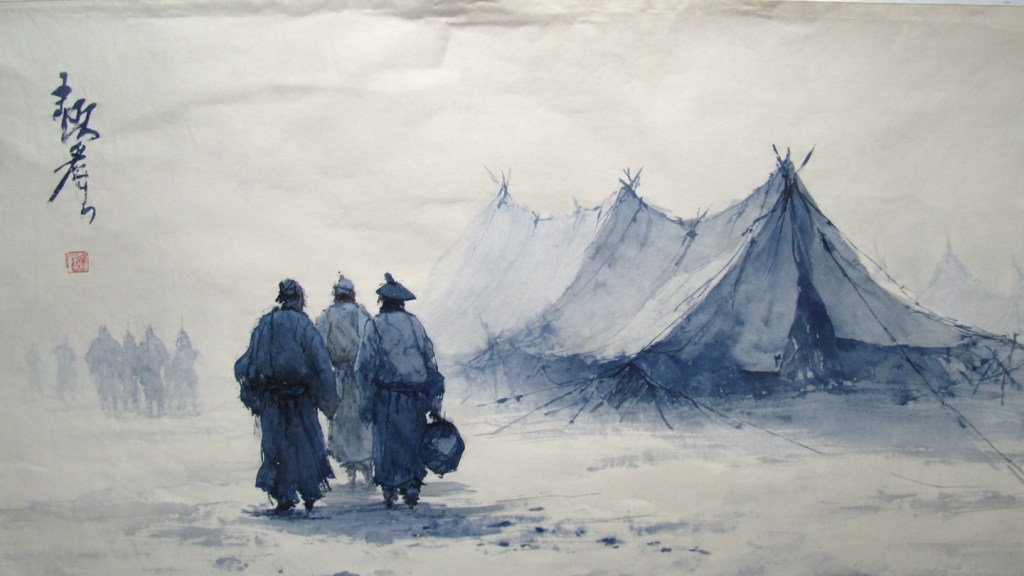
    The camp of Israel was beginning to wake.

    Morning light slid slowly across the valley floor. Leather straps tightened. Shields were lifted from the ground where they had rested through the night. The low murmur of soldiers preparing for another day moved quietly through the tents.

    Two victories lay behind them.

    Jericho.

    Ai.

    In the tent of Joshua, several elders stood around a rough wooden table. No maps covered its surface. Only a few stones rested there, markers of cities that had already fallen and cities that still waited somewhere beyond the hills of Canaan.

    The land ahead remained wide.

    Outside the camp, a small group of travelers approached along the road.

    Their pace was slow, the way people walk after a long journey. Dust clung to their clothing. Their sandals were worn thin along the edges. One of them carried a sack from which the corner of a loaf could be seen.

    The bread looked hard.

    From a distance they appeared like men who had walked for many days.

    The guards at the edge of the camp noticed them first.

    They raised their hands for the travelers to stop.

    No one in the camp yet knew who they were.

    And no one yet knew that the journey they claimed to have taken had never happened at all.

    Scriptural Anchors

    Joshua 9:3–6
    Joshua 9:14
    Proverbs 3:5–6

    Quote

    “Man is often deceived not because he sees nothing,
    but because he believes too quickly what he wishes to be true.”
    — Augustine


    PART 1 — The Men at the Edge of the Camp

    The guards studied them carefully.

    Travelers were not unusual in those days. Word of Israel had spread quickly through the land, and not everyone who approached the camp came with weapons in their hands.

    But these men looked different.

    Their clothing carried the gray dust of long roads. The seams of their garments had been patched more than once. Even the leather skins they carried at their sides appeared old and cracked, as though they had been filled and emptied many times along a distant journey.

    One of the guards pointed toward the sack.

    “What do you want?”

    The men answered with careful respect.

    They had come, they said, from a country very far away.

    The elders of their land had heard what the God of Israel had done in Egypt. They had heard of the kings beyond the Jordan who had fallen before Israel’s advance. The stories had traveled far—farther, perhaps, than the armies themselves.

    So they had come to ask for peace.

    One of the travelers reached into the sack and drew out the loaf.

    It was dry and hard beneath his fingers.

    “When we left our homes,” he said quietly, “this bread was warm from the oven.”

    He did not need to say more.

    The evidence seemed simple enough.

    The guards exchanged a glance before leading the men deeper into the camp, toward the tent where Joshua and the leaders of Israel were gathered.

    Inside, the elders listened while the travelers spoke.

    They showed their worn garments. They opened their weathered wine skins. They repeated their story of a distant land and a long road.

    Everything about them appeared old.

    Everything about them appeared consistent.

    And sometimes the most convincing deception is the one that seems to require the least explanation.

    Joshua looked at the travelers for a long moment.

    Outside the tent the camp continued its morning routine. Soldiers moved past without knowing what was being decided inside.

    A treaty with a distant people seemed like a small matter.

    The land ahead still held many cities.

    Many kings.

    Many battles yet to come.

    No one in the tent realized how much would follow from that simple meeting.


    Scriptural Anchors

    Joshua 9:6
    Joshua 9:9–10
    Proverbs 14:12

    Quote

    “Not everything that appears reasonable leads to truth.”
    — Thomas Aquinas

  • PART 2 — The Decision in the Tent

    The travelers finished their story.

    For a moment the tent was quiet.

    Joshua did not speak immediately. The elders studied the men before them as if weighing something that could not easily be measured. Outside, the sounds of the camp drifted through the open entrance—metal brushing softly against metal, a horse shifting its weight against a stake, voices carrying faintly across the morning air.

    The travelers waited.

    They did not press their request again.

    They had already said what they came to say.

    One of the elders reached forward and took the loaf that had been placed on the table. The crust was dry beneath his fingers. When he pressed it slightly, the bread did not bend.

    He passed it to another man.

    The second elder examined the worn wine skin beside it. The leather had darkened with age, and a seam near the top had clearly been repaired.

    Everything appeared consistent with the story they had heard.

    The elder turned the loaf once more in his hands, as if the answer might still be hidden somewhere in the crust.

    Another elder nodded slowly.

    “If they have come from so far,” he said, “they will not trouble the land.”

    The words were spoken quietly, almost as if the matter had already been settled.

    The travelers lowered their heads in respectful silence.

    Joshua looked from the bread to the men who stood before him. The camp beyond the tent continued its morning rhythm. Soldiers were already preparing for the next movement toward the hills of Canaan. The road ahead promised many battles.

    A treaty with a distant people seemed a small decision in the midst of greater concerns.

    At last the leaders of Israel spoke the words the travelers had hoped to hear.

    Peace would be granted.

    A covenant would be made between them.

    Oaths were spoken.

    Names were invoked.

    The agreement was sealed beneath the name of the Lord.

    The travelers bowed deeply.

    For them the moment felt like deliverance.

    For Israel it felt like a minor decision made in the course of a much larger campaign.

    But some decisions do not reveal their weight immediately.

    They wait.

    And only later does a man discover that the simplest agreement can carry consequences far beyond the moment it was spoken.


    Scriptural Anchors

    Joshua 9:14–15
    Joshua 9:18–19
    Ecclesiastes 5:4–5

    Quote

    “The beginning of wisdom is to seek the counsel of God before trusting the judgment of men.”
    — Gregory the Great

  • PART 3 — Three Days Later

    Three days passed before the truth arrived.

    The camp had already begun preparing for the next movement into the land. Scouts had been sent along the ridges to watch the nearby valleys. Small groups of soldiers moved in and out of the camp, learning the terrain that stretched beyond the hills.

    It was one of those scouting parties that brought the news back.

    At first the report sounded uncertain.

    One of the men spoke quietly to the guards at the edge of the camp, pointing toward the hills that lay only a short distance away. Another man repeated the name he had heard from villagers along the road.

    Gibeon.

    The name passed from one voice to another.

    Someone recognized it.

    Gibeon was not a distant country.

    It was one of the cities of the land.

    The realization moved through the camp slowly, the way a shadow moves when a cloud passes across the sun. At first it touched only a few men who had heard the report. Then more voices repeated the name.

    Gibeon.

    A city close by.

    Very close.

    Too close for the story the travelers had told.

    Men began to gather outside the tent of the leaders. Their voices were low at first, but the tone was no longer uncertain. They were not arguing about what had happened.

    They already understood.

    Inside the camp, memories of the visitors returned with a different weight. The worn clothing. The cracked wine skins. The careful story of a distant journey.

    What had seemed convincing now appeared deliberate.

    Joshua stepped out from the tent.

    The crowd parted slightly as he came forward. No one shouted accusations. The anger in the camp had not yet found words. It hung in the air like a tension waiting to break.

    A scout spoke again.

    The city of Gibeon stood only a short distance away.

    Three days.

    That was all the distance between the story they had believed and the truth that now stood before them.

    Joshua did not answer immediately.

    He looked across the camp where soldiers were beginning to understand the same thing at the same time.

    The covenant had already been sworn.

    And the oath had been spoken in the name of the Lord.

    Some mistakes reveal themselves slowly.

    This one had taken only three days.

    And sometimes the most painful discovery is not that someone else has deceived you—

    but that the moment of deception passed through your own hands without being questioned.

    Scriptural Anchors

    Joshua 9:16
    Joshua 9:14
    Joshua 9:18–19

    Quote

    “Many errors are born not from wickedness,
    but from acting before seeking the counsel of God.”
    — John Chrysostom

  • PART 4 — The Oath That Could Not Be Withdrawn

    The men of Gibeon were brought back before Joshua.

    This time they did not pretend to be travelers from a distant land. The story that had carried them safely into the camp had already collapsed. There was no reason to repeat it now.

    They stood quietly in the open space before the leaders of Israel.

    Dust clung to their garments. Their faces carried the weariness of men who had run out of explanations.

    Joshua stepped forward.

    His question was simple.

    “Why did you deceive us?”

    One of the men answered.

    Not with the careful voice they had used before, but with the blunt honesty of someone who had nothing left to hide.

    “Because we were afraid.”

    The words settled heavily over the gathering.

    They had heard what the God of Israel had done in Egypt. They had heard of the kings who had fallen east of the Jordan. They had heard what had happened at Jericho.

    And at Ai.

    Every city in the land was beginning to hear the same stories.

    Some chose to prepare their armies.

    Gibeon had chosen something else.

    “We feared greatly for our lives,” the man continued.

    “So we acted.”

    The crowd around them stirred uneasily.

    Fear was not difficult to understand.

    But deception was harder to forgive.

    Several voices rose among the soldiers. Some argued that the covenant should be broken. Others demanded that the city of Gibeon should fall like the rest of the cities of the land.

    Joshua listened without interrupting.

    Then he looked toward the elders who had spoken the oath with him only days before.

    The words of the covenant had been spoken in the name of the Lord.

    That name could not be used lightly.

    Breaking the agreement might satisfy the anger of the camp.

    But it would stain the name by which the oath had been made.

    For a moment the space between the two groups remained silent.

    Then Joshua spoke.

    “You will live,” he said.

    A murmur moved through the people.

    “But you will not stand as equals among Israel.”

    He pointed toward the sanctuary.

    “You will serve.”

    Cutters of wood.

    Carriers of water.

    Servants for the house of God.

    The men of Gibeon lowered their heads.

    For them the judgment still meant life.

    And for Israel the decision carried a quieter lesson.

    Some promises are made in wisdom.

    Others are made in haste.

    But once the name of the Lord has been spoken over them, both must be carried.

    Even when the cost becomes clear only afterward.


    Scriptural Anchors

    Joshua 9:22–23
    Joshua 9:19
    Ecclesiastes 5:4–5

    Quote

    “It is better to bear the burden of a promise spoken in haste
    than to dishonor the name by which it was sworn.”
    — Basil the Great

  • PART 5 — The Trouble That Followed

    The men of Gibeon left the camp of Israel alive.

    Only a few days earlier they had walked toward the tents with uncertainty in every step. Their plan had depended entirely on whether the leaders of Israel would believe the story they carried.

    Now the outcome was clear.

    They had survived.

    Their city would not be destroyed like Jericho.

    It would not burn like Ai.

    Yet the road back to Gibeon felt different from the road that had brought them to Israel’s camp.

    They returned not as free men.

    They returned as servants bound by a covenant.

    From the hills above the city walls, the people of Gibeon watched their leaders approach.

    The gates opened.

    The news spread quickly through the streets.

    Some rejoiced simply because the city would live.

    Others understood that the price of survival had already been set.

    Gibeon would belong to Israel now.

    But the consequences of their decision did not stop there.

    News of the treaty began to move through the land faster than the travelers themselves.

    Messengers carried the report from city to city.

    Gibeon had made peace with Israel.

    For the kings of the Amorites, the news was alarming.

    Gibeon was not a small village hidden among the hills. It was a great city, stronger than many of its neighbors. If such a city had chosen submission instead of resistance, what might the other cities of the land decide to do?

    The answer seemed dangerous.

    So the kings chose to act.

    Adoni-zedek of Jerusalem sent word to the rulers of Hebron, Jarmuth, Lachish, and Eglon.

    Five kings gathered their armies.

    Their target was not Israel.

    It was Gibeon.

    The city that had escaped destruction through deception would now face another threat—one that no disguise could turn away.

    Sometimes a man escapes one danger only to discover that the path he chose leads directly into another.

    And the clever plan that saved Gibeon from Israel would soon place them in the middle of a war far larger than they had imagined.

    Scriptural Anchors

    Joshua 10:1–2
    Joshua 10:3–5
    Psalm 20:7

    Quote

    “The wisdom of men may escape one danger,
    but only the providence of God governs what comes after.”
    — Augustine of Hippo


    CODA — The Weight of Small Decisions

    The story of Gibeon begins with something small.

    A group of travelers.

    Worn clothing.

    A loaf of hardened bread.

    No battle was fought that day.

    No walls collapsed.

    No army marched across the valley.

    Only a conversation inside a tent.

    Yet that quiet meeting carried consequences that stretched far beyond the moment itself.

    Israel discovered that a decision made without seeking the counsel of God could bind them in ways they had never intended.

    Gibeon discovered that cleverness might preserve life, but it could not control what followed afterward.

    The treaty stood.

    The oath had been spoken in the name of the Lord, and it could not be undone.

    From that point forward both nations would live with the weight of that moment.

    History often turns on events that appear small at first.

    A hidden piece of gold beneath a tent.
    A spear lifted on the battlefield of Ai.
    Or a loaf of bread placed upon a table as evidence of a journey that never happened.

    And sometimes the difference between wisdom and regret
    is decided in a quiet moment—

    between the question that is asked,
    and the one that is never spoken.

  • INTRO — The General and the Two Mounds

    Joshua was back at the same table.

    The wood was rough beneath his palms. Morning light slipped through the opening of the tent and spread slowly across the surface. There were no maps laid out there. No ink. No carved markers showing the movement of armies.

    Only the plain grain of wood.

    This morning he brought something with him.

    Two small mounds of earth.

    He had gathered the soil outside the camp while the air was still cool. Now he placed the first mound near the center of the table and pressed it together with his fingers until it held its shape.

    Compact. Firm.

    It stood for Jericho.

    The city whose walls had collapsed beneath the sound of a shout. The victory that had come through silence and obedience rather than siege.

    Joshua did not say the name aloud.

    He simply looked at the mound for a moment.

    Then he reached again for the loose soil beside him.

    The second mound was smaller.

    The dirt did not hold together as easily this time. It broke apart once before he pressed it again into shape. A few grains fell back onto the table.

    This one stood for the valley of Achor.

    For the stones that covered Achan.

    For the place where buried gold had brought thirty-six men down on the slope of Ai.

    Two mounds.

    One for a city that had fallen.

    One for a grave that had been opened.

    Outside the tent the camp was beginning to stir. Leather straps tightened. Metal brushed softly against metal. The low murmur of waking soldiers moved through the morning air.

    Beyond the camp, the ridge of Ai could already be seen.

    The same ridge.

    The same narrow rise of earth where Israel had once climbed—and then run back down.

    Joshua rested his hand on the table.

    Between the two mounds of soil, the hill outside waited quietly.

    God had spoken again.

    But returning to a place where you once fled is never simple.

    And the ridge ahead had already seen Israel run.

    Scriptural Anchors

    Joshua 8:1 — “Do not fear or be dismayed. Take all the fighting men with you, and arise, go up to Ai.”

    Joshua 7:26 — The valley of Achor, where Achan was buried beneath stones.

    Deuteronomy 31:8 — “It is the Lord who goes before you. He will be with you; He will not leave you or forsake you.”


    PART 1 — The Same Path Up

    Morning light moved slowly across the valley.

    The air still carried the cool edge of night, but the ground was beginning to warm under the rising sun. Soldiers moved through the camp in quiet preparation. Sand shifted under sandals. Shields were lifted from the ground where they had leaned against tent poles. Straps were pulled tight across armor that had been loosened during the night.

    This time no small detachment was sent.

    The entire army moved.

    Joshua walked at the front.

    The road toward Ai had not changed since the last battle. The path climbed gradually from the valley floor, narrowing in places where loose rock slid beneath the foot. Small stones rolled down the slope when a man stepped carelessly.

    Men watched their footing.

    No one spoke about the last time they had walked this road.

    They did not need to.

    Places remember even when people try not to say their names.

    Somewhere along this same ascent thirty-six bodies had fallen. The dust had swallowed their blood quickly. Wind had erased the footprints of the retreat. By the next day the hillside had looked like any other piece of ground in Canaan.

    Hills do not carry memory.

    Men do.

    Ai appeared again on the ridge above them.

    Its walls were modest compared to Jericho. From a distance the city almost looked ordinary—stone laid upon stone, a gate set into the wall, the slope rising toward it in quiet lines of earth and rock.

    That ordinariness had been deceptive once.

    Joshua studied the terrain as they walked.

    This time the command had been different.

    No circling walls.

    No silent march for seven days.

    God had given instruction suited to this moment.

    Some men would move through the darkness behind the city during the night. Others would approach openly from the valley. The plan would unfold slowly, step by step, until the city believed it was seeing the same battle it had already won.

    Joshua lifted one hand.

    The army stopped.

    Dust settled around their feet.

    From the ridge above, the men of Ai could see them again.

    The same people.

    The same valley.

    The same path of approach.

    Perhaps the king of Ai remembered the last battle.

    Perhaps he expected the same ending.

    Joshua did not know what the city expected.

    He only knew this:

    The road up the hill was the same.

    But the nation walking it was not.

    Scriptural Anchors

    Joshua 8:1–2 — God commands Joshua to rise and attack Ai again.

    Psalm 56:3 — “When I am afraid, I put my trust in you.”

    Isaiah 41:10 — “Do not fear, for I am with you.”

    Quote

    “Trust the past to the mercy of God,
    the present to His love,
    and the future to His providence.”
    — Augustine of Hippo

  • PART 2 — The King Who Had Already Won

    Inside the walls of Ai, the king had already heard the reports.

    Israel was coming again.

    Messengers had carried the news from the valley. The same people who had once fled the slope were now gathering below the ridge again. Dust from their movement could already be seen rising in the distance.

    The king did not seem troubled.

    He had seen this army before.

    The memory of the last battle still lived in the city. Men remembered how Israel had turned and run down the hill. They remembered the shields abandoned on the slope and the bodies left behind in the dust.

    Victory does something strange to the mind.

    It takes a moment that happened once and stretches it forward as if the future must follow the same path.

    From the wall the king watched the valley slowly filling with movement.
    Dust lifted where the Israelites gathered below the ridge.

    He had seen this scene once before.

    In his mind the ending was already written.

    From the wall the valley looked familiar.

    The road climbing toward the gate had not changed. The same ridge stood between the city and the plain. The same path carried soldiers upward from the valley floor.

    What had worked before would work again.

    At least that is how memory often speaks.

    Down in the valley Joshua was arranging the army.

    Behind the hills west of the city, thirty thousand men had already moved into the darkness during the night. They lay among the rocks where the city could not see them.

    But inside the walls of Ai, none of that movement was visible.

    The king only saw what he expected to see.

    Israel had returned.

    And the last time Israel had come, the story had ended quickly.

    Confidence is a quiet architect of blindness.

    It builds certainty out of yesterday’s victory and calls it wisdom.

    The king of Ai believed he already understood how this battle would end.

    The gate would open.

    The men of the city would descend the ridge.

    And Israel would run again.

    Scriptural Anchors

    Joshua 8:10–11 — Joshua and the army move toward Ai.

    Joshua 8:14 — The king of Ai sees Israel and goes out to battle.

    Proverbs 16:18 — “Pride goes before destruction, and a haughty spirit before a fall.”

    Quote

    “Pride is the beginning of every sin, because it turns the heart away from God.”
    — Augustine of Hippo